DRM: Complication
Material:
Enter the Devosphere
higaara/dino: Reasons for DRM on Independent Content
Enter the Devosphere: DRM on Independent Content
Daring Fireball: Would Apple Mix DRM and Non-DRM Music at the iTunes Store?
Stairways Software: Why Apple Cannot Allow DRM-free Indie Music
The Poisoned Project - Poisoned
MP3 music download website, eMusic
USATODAY.com - EMusic's pitch: Download song and own it
higaara/dino: Thoughts On Thoughts On Steve Jobs Thoughts on Music Minus Macrovision's Response
Apple - Thoughts on Music
Rolling Stone :Steve Jobs: The Rolling Stone Interview
Artem over at Enter the Devosphere has a good rebuttal of my piece entitled DRM on Independent Content. Of course, I take issue with several of his points.
DRM Vs. Non-DRM
In reference to the the above quote from my post, Artem states:
The list of differences between DRM'ed and non-DRM'ed content (in the context of iTunes):
Artem believes that most users won't notice the difference. I disagree. In the same blog post that both I and Artem link to, John Gruber himself states that even if a simple icon was used to distinguish both DRM and Non-DRM'ed content, it still probably wouldn't be effective:
People do more with their music than just listen to it. Over the period of a year, someone might burn CD's of it, share it online, move it to multiple computers and put it on different pieces of hardware. These are just some of the potential uses of digital music.
The problem with DRM, as indicated by both Peter Lewis and John Gruber, is not that it explicitly stops customers from doing what they want with their music, but that it's an impediment to what they want to do with their music. That's the rub with DRM: it introduces complications that feel arbitrary. Why do they feel arbitrary? Well, because DRM doesn't work, mostly because true freedom with your iTunes-bought music is just a burn away.
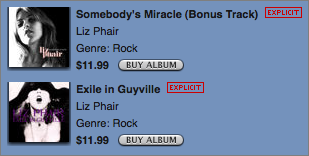
Yes, such a point is valid, however, the difference between DRM'ed and non-DRM'ed content is far more significant than the difference between Explicit and Clean content. Explicit and Clean content can pretty much be used in much the same way. That situation just isn't possible with DRM'ed and non-DRM'ed content being sold at the same location.
In reference to the the above quote from my post, Artem states:
DRM’ed and non-DRM’ed music can also be used in the same way… listened to. DRM or non-DRM does not change how a normal user (non-pirate) uses music. Either way, they get their song, put it on their iPod and enjoy listening to it. The only thing that is affected is the subtleties of sharing. Most users already deal with these differences due to the fact that they don’t buy all their music from iTunes but download some from limewire or indie sites like www.3hive.com .The list of differences between Explicit and Clean content:
- Explicit content can be 'turned off' using iTunes parental controls.
The list of differences between DRM'ed and non-DRM'ed content (in the context of iTunes):
- DRM'ed content can only be played on (generally) Apple branded hardware and software while non-DRM'ed content can be played on any device that supports the particular format.
- DRM'ed content from one particular account can only be played on up to 5 computers. Non-DRM'ed content can be played on any number of computers
- Computers that can play DRM'ed content must be authorized to play that person's DRM'ed content. Authorization is not required for DRM content to be played on a person's music. Subsequently, deauthorization is required for when the user moves to a new computer.
- DRM'ed content is effectively impossible to share
Artem believes that most users won't notice the difference. I disagree. In the same blog post that both I and Artem link to, John Gruber himself states that even if a simple icon was used to distinguish both DRM and Non-DRM'ed content, it still probably wouldn't be effective:
I see no reason why Apple couldn’t devise a little icon to represent FairPlay-protected songs. But Peter Lewis is right that no matter what Apple does, it would only matter for iTunes users who are paying attention — and most users don’t pay attention.Peter Lewis also gives some good points in a post that Gruber links to:
Even with a single consistent set of rules, DRM is complicated. (How many people have forgotten to deauthorize an old or broken computer before getting rid of it?) Selling a mix of DRM-laden and DRM-free music wouldn’t pose any serious technical hurdles for Apple, but it would pose some design challenges.
The answer is pure Apple through and through. The tyranny of choice. Think about the consequence of iTunes Music Store offering some music in FairPlay, some in unprotected MP3 format. Now every song needs to be clearly marked as which format it will be purchased in! No longer can I just click the Buy buttong and know what I am getting.
But how would this be communicated? A special “flag” icon to indicate format - that would not likely be noticed. A dialog box on purchase - people do not read them, and already ignore the current ones. The net result would be confused consumers wondering why some music they purchase works with their Zen and other purchased music will not play. Lots of angry customers. The result: a degrading of the iTunes Music Store experience and customer loyalty.
People do more with their music than just listen to it. Over the period of a year, someone might burn CD's of it, share it online, move it to multiple computers and put it on different pieces of hardware. These are just some of the potential uses of digital music.
The problem with DRM, as indicated by both Peter Lewis and John Gruber, is not that it explicitly stops customers from doing what they want with their music, but that it's an impediment to what they want to do with their music. That's the rub with DRM: it introduces complications that feel arbitrary. Why do they feel arbitrary? Well, because DRM doesn't work, mostly because true freedom with your iTunes-bought music is just a burn away.
As an example of other aspects of digital music that Artem believes people have a harder time with, he states:
Really? Well, let's take a look. The following screenshots are pics I've taken of a P2P filesharing program called Poisoned. Using Poisoned, I've searched for a particular popular track:


How about a lesser known title:

From these screenshots, it's clear that most of the tracks on filesharing networks such as Gnutella and Ares are provided in the widely used MP3 format, which both iTunes and the iPod (as well as all Apple software and hardware) natively support. AAC and WAV are also natively supported in iTunes and Apple hardware. Even WMA will automatically be converted to a format of the user's choice when they try to import it into iTunes. As for OGG, tracks in that format are actually hard to find and are very unlikely to show up in a user's music search. And there already exists free utilities that will convert any OGG track into an MP3. This is something that alot of iPod users are already familiar with, as there are already plenty of people who use similar utilities to convert videos into an iPod ready format.
Plus, once the music has been imported into the person's library, they don't have to worry about it anymore. The same can't be said of DRM'ed music. It's entirely conceivable that one would want to send tracks to multiple people over a period of time, or that one would want to burn a playlist with a specific DRM'ed song for the 7th time a couple of months after they purchased the track, or, as Gruber states, that one might run into their 5 computer limit just from forgetting to deauthorize a computer, or any combination of these things. DRM presents a multitude of variables that can easily cause customer confusion and frustration. In contrast, the importing of different types of tracks is largely transparent due to most of the internet standardizing on unrestricted MP3's.
But that involves expecting people to know what the difference is between between 8bit and 16bit music, or at least knowing the differences it causes. Users don't care about the bitrate or how the track measures in a 'quality scale'. Ultimately, their idea of quality is subjective: if it sounds ok, then they'll get it1.
Except the Big 4 already have evidence of this working: eMusic. eMusic currently holds the number 2 spot for online music sales with an 11% marketshare. That's nearly double the marketshare of their closest competitor, Real Rhapsody. And every single song they sell is in an unprotected MP3 format, therefore, all the music on eMusic comes from Indie artists and labels. The same Indie labels that sell their music on iTunes.
Now, my bet is that the music industry will eventually go for unprotected music, but not because they'll think that it makes them more money, but so that they can remain in a position of power. From a previous post of mine:
If the music labels didn't enforce DRM, then the situation I've outlined would have been far less likely. That's because Apple's DRM scheme only works with iTunes and the extremely popular iPod and vice versa, greatly discouraging users to not buy their music from other online services. The only way the music labels can defuse this situation is to stop enforcing DRM and instead let all the music stores sell unprotected content that can work on any music player, thereby increasing other music stores' share of the market and creating a more level marketplace in terms of marketshare. In this situation, the Big 4 have far more leverage in discussions they have with music distribution services.
But then why would Apple even allow such an essay to be penned and prominently placed on the front page of their main website? It's not even so much that Steve Jobs made an essay about the subject, but that he explicitly states in clear terms why DRM doesn't work at all. If what Artem says is true, this essay seems more counter-intuitive than anything else.
And how can Apple use their system to lock users in if only 3% of an iPod owner's music is from iTunes:
Plus there's this statement from Steve Jobs in a Rolling Stones interview back in 2003:
I don't think that Apple actually cares about, or likes, DRM. Along with complications for the user, DRM involves a complicated platform of locks, keys and checks to support it that's costly to maintain. The only reason that iTunes exists is to have a source of digital content for the Mac, iPod and any other products Apple might release.
One of the main reasons why I think Apple made this essay is because they're worried. Worried that the music labels' increasingly arrogant attitude and their continued antagonizing of customers are going to push people away from legally purchasing music and instead towards other means of legal and illegal means of getting unprotected content. This would be a bad thing for Apple, as the iTunes Store is becoming an increasingly bigger selling point for Apple products. If people stop caring about it, then that business advantage of having an end to end (purchase to listen) system becomes irrelevant.
1: Why else would people be willing to pay $10 on iTunes for a 128kbps encoded album when they can pay the same amount or a little more for a CD that's lossless?
2: I don't quite understand this last sentence. The iPod is an open platform when it comes to the type of formats it accepts. The only thing that's really closed about it is that it's DRM isn't licensed to other music distributors and/or hardware manufacturers. But that's significantly different from 'more open MP3'.
This slight sharing difference is much simpler than some more significant music differences users’ deal with. Some of their music is in mp3, some in wav, some in Apple’s aac, some in other formats (ogg anyone?).
Really? Well, let's take a look. The following screenshots are pics I've taken of a P2P filesharing program called Poisoned. Using Poisoned, I've searched for a particular popular track:


How about a lesser known title:

From these screenshots, it's clear that most of the tracks on filesharing networks such as Gnutella and Ares are provided in the widely used MP3 format, which both iTunes and the iPod (as well as all Apple software and hardware) natively support. AAC and WAV are also natively supported in iTunes and Apple hardware. Even WMA will automatically be converted to a format of the user's choice when they try to import it into iTunes. As for OGG, tracks in that format are actually hard to find and are very unlikely to show up in a user's music search. And there already exists free utilities that will convert any OGG track into an MP3. This is something that alot of iPod users are already familiar with, as there are already plenty of people who use similar utilities to convert videos into an iPod ready format.
Plus, once the music has been imported into the person's library, they don't have to worry about it anymore. The same can't be said of DRM'ed music. It's entirely conceivable that one would want to send tracks to multiple people over a period of time, or that one would want to burn a playlist with a specific DRM'ed song for the 7th time a couple of months after they purchased the track, or, as Gruber states, that one might run into their 5 computer limit just from forgetting to deauthorize a computer, or any combination of these things. DRM presents a multitude of variables that can easily cause customer confusion and frustration. In contrast, the importing of different types of tracks is largely transparent due to most of the internet standardizing on unrestricted MP3's.
Some music is 8bit, some 16bit, and myriad other differences. I think it is naïve to think that iPod users will be confused or frustrated by the presence of non-DRM music in the iTunes Store.
But that involves expecting people to know what the difference is between between 8bit and 16bit music, or at least knowing the differences it causes. Users don't care about the bitrate or how the track measures in a 'quality scale'. Ultimately, their idea of quality is subjective: if it sounds ok, then they'll get it1.
Also, by introducing a distinction between DRM and non-DRM music Apple can collect data and what music users prefer. Then they can turn to the big companies and start talking in their language of money but simply bringing up stats and saying: “look small label X made twice the money as equivalent small label Y by selling non-DRM music”. Maybe then Big Music would listen.
Except the Big 4 already have evidence of this working: eMusic. eMusic currently holds the number 2 spot for online music sales with an 11% marketshare. That's nearly double the marketshare of their closest competitor, Real Rhapsody. And every single song they sell is in an unprotected MP3 format, therefore, all the music on eMusic comes from Indie artists and labels. The same Indie labels that sell their music on iTunes.
Now, my bet is that the music industry will eventually go for unprotected music, but not because they'll think that it makes them more money, but so that they can remain in a position of power. From a previous post of mine:
...there's also the fact that the music labels don't have a lot of control when it comes to the sales of music online. That's because they've put all of their eggs in one basket: iTunes. Apple wields so much power with legal online music sales that the music labels actually find it hard to negotiate with them. Take the labels' push for variable pricing for individual tracks as an example. They were out there publicly boo-hooing about how they should be the ones to decide the pricing of their songs. Except, well, it never happened. Every song on iTunes in every country that it's available (except for Japan) has a flat-rate pricing structure and the prices never changed.
If the music labels didn't enforce DRM, then the situation I've outlined would have been far less likely. That's because Apple's DRM scheme only works with iTunes and the extremely popular iPod and vice versa, greatly discouraging users to not buy their music from other online services. The only way the music labels can defuse this situation is to stop enforcing DRM and instead let all the music stores sell unprotected content that can work on any music player, thereby increasing other music stores' share of the market and creating a more level marketplace in terms of marketshare. In this situation, the Big 4 have far more leverage in discussions they have with music distribution services.
Apple's Close-To-The-Chest DRM
Artem also states what he thinks is the reason why Apple won't release Indie content as unprotected tracks:I think the reason Apple is really continuing to sell all their music as DRM is to hold on to their proprietary rights. Regardless of what Steve Jobs publishes as “his opinions” on DRM music, Apple is still a heartless capitalist corporation. By sticking to DRM, they make sure people can only easily listen to the music on their iPods and not competitors. This way iTunes Store and iPod become a bundle and exclusive “cool” society that other more open MP3 users can’t join2.
But then why would Apple even allow such an essay to be penned and prominently placed on the front page of their main website? It's not even so much that Steve Jobs made an essay about the subject, but that he explicitly states in clear terms why DRM doesn't work at all. If what Artem says is true, this essay seems more counter-intuitive than anything else.
And how can Apple use their system to lock users in if only 3% of an iPod owner's music is from iTunes:
under 3% of the music on the average iPod, is purchased from the iTunes store and protected with a DRM.And even if that particular estimate isn't true (there is some debate over the math Steve Jobs employs), it is still widely agreed upon that most iPod owners music collections either don't contain music from iTunes or contain very little.
Plus there's this statement from Steve Jobs in a Rolling Stones interview back in 2003:
We have Ph.D.'s here, that know the stuff cold, and we don't believe it's possible to protect digital content.
...And it only takes one stolen copy to be on the Internet. And the way we expressed it to them is: Pick one lock -- open every door.
I don't think that Apple actually cares about, or likes, DRM. Along with complications for the user, DRM involves a complicated platform of locks, keys and checks to support it that's costly to maintain. The only reason that iTunes exists is to have a source of digital content for the Mac, iPod and any other products Apple might release.
One of the main reasons why I think Apple made this essay is because they're worried. Worried that the music labels' increasingly arrogant attitude and their continued antagonizing of customers are going to push people away from legally purchasing music and instead towards other means of legal and illegal means of getting unprotected content. This would be a bad thing for Apple, as the iTunes Store is becoming an increasingly bigger selling point for Apple products. If people stop caring about it, then that business advantage of having an end to end (purchase to listen) system becomes irrelevant.
1: Why else would people be willing to pay $10 on iTunes for a 128kbps encoded album when they can pay the same amount or a little more for a CD that's lossless?
2: I don't quite understand this last sentence. The iPod is an open platform when it comes to the type of formats it accepts. The only thing that's really closed about it is that it's DRM isn't licensed to other music distributors and/or hardware manufacturers. But that's significantly different from 'more open MP3'.